Sunday, June 6, 2010

The Calm After The Storm, or, Birthday Celebrations Galore!

Hola amigos,
Things are settling back to normal here in Xela. Guatemala is certainly still in disaster relief mode, and while the roads are bad, the selection is down and the prices are up in the markets, and generally things are just messy across the city, Xela is more or less back on its feet. The pictures coming in from other parts of the region and country are shocking - the neighborhood fifteen minutes (by foot) from my apartment experienced flooding up to the second floor of buildings, and a community twenty minutes away by bus had several cinderblock homes collapse completely into ravines. The craziest part of Agatha for me, though, is to hear people talk about this storm with the acceptance and certainty that the rainy season is just beginning, and that more heavy rains and/or tropical storms are sure to come. Hopefully we'll have a respite of at least a few weeks.

The clinic saw very few patients most of this week - there was a rush on Friday, but we suspect most community members were too busy evaluating storm damage and repairing homes/fields to take time off to visit the doctor. The school doors in the valley were also shuttered this week, but we'll be starting a series of in-school lessons in Llanos del Pinal this Monday when classes resume. Llano is the largest school in the valley with almost 1300 students, so my compañera and I should have our hands full for the next several weeks. The Education Team is now five volunteers strong and expecting up to six more this week (exact quantity uncertain because of storm/volcano-related chaos in the airport), and I'm hoping at least two more volunteers can join us in Llano so that it doesn't take the rest of my summer to teach the requisite three lessons each to a total of 38 classes. A great deal depends on the incoming volunteers' education backgrounds and Spanish language abilities. We'll see what happens!

Unrelated to the Education Team's official activities, the clinic did play host to one of my birthday parties last Friday. Since Friday also marked the end of the medical students' eight week rotation, Primeros Pasos closed an hour early so we could celebrate accordingly. Along with three different types of cake, the fiesta also featured a piñata Scott bought me for my birthday. Here I am trying to bust it open:


I must admit I was a bit timid in my whackings - the pole that I was given was at least three feet long and I was afraid of accidentally clubbing a co-worker. After the assistant clinic director, women's program assistant director, clinic doctor, and clinic director also unsuccessfully endeavored to break open the piñata, it fell to Scott to unleash the candy:
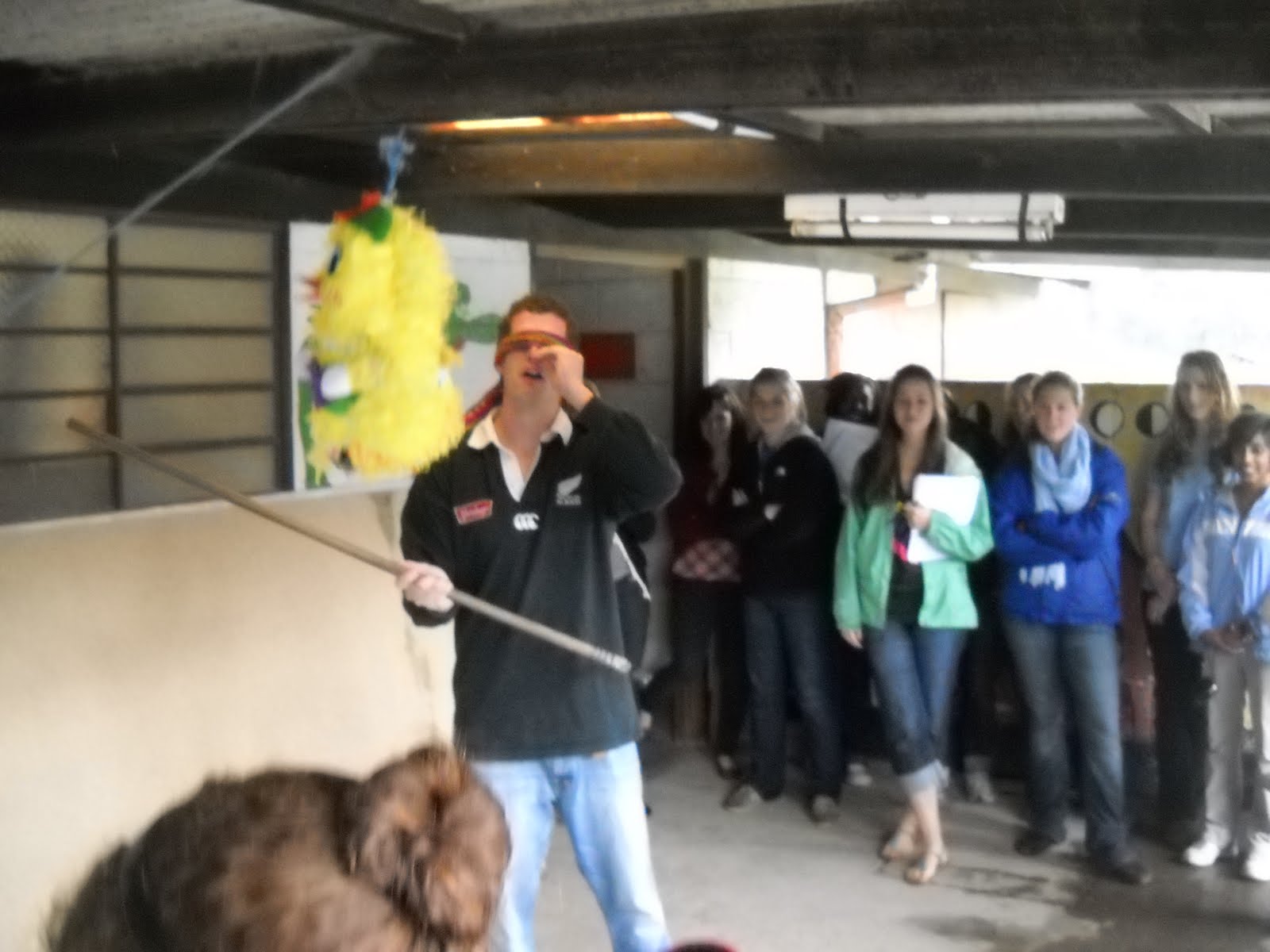

He succeeded and the clinic staff and volunteers consumed even more sweets. Our dentist graciously said he would be waiting for us whenever our teeth rotted.

That Friday night, Scott and I and a few friends met up at a wine bar around the corner to continue my birthday celebration with a few glasses of Chilean Cabernet Sauvignon and plates of fondue. Despite the imminent arrival of tropical storm Agatha, we managed to stay dry and enjoy ourselves enough that my former homestay brother decided to have his birthday celebration there the following Friday. Zero points for creativity, but lots of fun both times. Pictures are on facebook, I believe.

As if two birthdays in a week weren't enough, the little boy from my homestay family turned four this weekend as well. Needless to say, there was a large fiesta Saturday afternoon. To start off the festivities, there was a balloon popping competition. As shown below, the aim of the game is to inflate your balloon and pop it between you and your partner's tummies before the other pair can.


Scott and I were nominated to participate in a gringos-only competition, and I'm proud to say we beat Joe and Carlitos, two of the guests currently living with my former homestay family.

Here's a photo of the birthday boy with all his cousins and neighbors:


The Diego piñata in the background is bigger than most of the niños at the party. The cake was also spectacular and Diego-themed:


Also, in addition to piñatas and cake and paches (potato-based tamales wrapped in banana leaves), all the guests received party favors. Here's Scott proudly displaying his Diego 'sorpresa' - my party favor box was Strawberry Shortcake:


Aside from birthday parties, I stayed busy with Spanish lessons (I'm presently struggling with the conditional), yoga classes, and a European Union-sponsored free movie festival. Since Agatha prevented travel last weekend, the only adventuring Scott and I were able to do in the past two weeks was a Sunday morning day trip to Momostenango, a pueblo a little over an hour outside Xela that's famous for its wool blankets and jackets. Scott has been searching for a chumpa, a heavy wool sweater, for weeks now, so we pleaded with our Spanish teacher to take us to Momos and show us where the best chumpas were. Our maestra's family is originally from Momos, so not only did we have an almost-local guide us through the market and chumpa stores, but we also got to drop in on her 90 year old grandmother who still lives alone in the hills. I can definitely say that our trip to Momos would not have been nearly as enjoyable without Claudia's expertise. The market alone would have been overwhelming - the walkways were far too narrow and the old ladies' elbows far too aggressive for my liking, and Scott and I certainly would have missed the local specialty bread (made with brown sugar and denser than the bread found around Xela).

In addition, just outside of the city center are some pretty cool rock formations. Known as Los Riscos, they remind me of the Utah license plates only on a much smaller scale. This is the view from the street as you walk up:


And here's a view from the top:


And finally, here I am in my conquistadora pose:


All in all, a good week. I will keep updating in regards to the relief/recovery/reconstruction efforts as more progress (hopefully) is made, and this Thursday, I will travel to the capital to meet my mother in the airport as she comes to visit me for a long weekend. Two weeks after the fact, but a much anticipated birthday present nonetheless!

Sunday, May 30, 2010

Briefly...

Hola amigos,
I've elected not to do a full blog post this week in light of the weather-related craziness currently assaulting Guatemala.

Tropical Storm Agatha, though short-lived, nevertheless managed to dump a ton of rain across the country and hundreds of families have lost their homes to flooding and/or rain-induced mudslides. As of this evening, almost 75 deaths have been confirmed nationwide, and dozens more citizens remain unaccounted for. Xela itself has fared relatively well, but the city's outskirts are still experiencing flooding and water damage, and since yesterday, it's been impossible to leave the city.

Scott and I have just been staying inside all weekend, trying to keep warm and dry. Though the rain stopped early this morning, the forecasts call for wet weather through Tuesday. Schools will be closed for the rest of the week, and it remains to be seen whether the clinic will be open or not. The plan now is to meet at the bus stop as usual Monday morning and see a) if the bus route is open and b) if the clinic personnel will be able to reach Primeros Pasos and work a full day.

On top of the tropical storm and flooding, Pacaya volcano has been erupting and showering Guatemala City with volcanic ash. Combined with the rain, the ash has been forming a sort of cement in the streets of the capital. It's a big ole mess.

Please keep Guatemala in your thoughts and prayers, and I'll post an update once more details emerge.

Monday, May 24, 2010

Claro que si, mamita!


Buenas Tardes from Guatemala!

Last week was a bit off kilter but still terrific. The clinic was productive if hectic, I conquered (eventually) some intestinal amoebas, and we got to meet up with a Rice group at Lago Atitlan over the weekend. Great success!

Here's a quick photo taken from a boat on Lake Atitlan, just so that all my pictures aren't at the end of my post:


I'll start with my Primeros Pasos stories. Though I don't have any clinic pictures from this week, I did manage to bring a niño to tears in the hallway. It was traumatic for both of us, I think.

In the more than three months that I've been teaching classes, I have not had any discipline issues up until this week. For whatever reason though, it was taking longer than usual for the students to finish their checkups with the doctors, and the kids were arriving to the education lessons more antsy and squirmy than usual due to the extended wait. On Tuesday, one student in particular was acting up to the point of disrupting the lesson for the other niños. I warned him repeatedly that he would have to leave if he didn't start behaving himself better, but he didn't seem to give me any credence. When I ushered him out of the classroom after his 'final warning', then, he looked shocked that I had followed through on my threats, threw himself against the door of the pharmacy and started bawling. I explained that because he had been 'malcriado', he was keeping his fellow students from learning and the instructors from teaching and that's why I had removed him from class. If he wanted to try again, we could go back into the lesson together and listen quietly, or if he would rather color with me in another room or play outside until we finished teaching his classmates, that would be okay as well. No response, just sniffly tears. The dentist and a couple of medical students tried to cheer him up, too, to equally little avail. I eventually had to hand the niño llorando over to the clinic director, once it became evident that he wasn't going to stop crying and voluntarily leave the hallway anytime soon.

The episode actually upset me, too, because the niño's prolonged tears caught me by surprise. I certainly wasn't intending to ruin his day by removing him from class. Moreover, his classmates were especially eager to fingerpoint at this student for misbehaving, indicating that perhaps he isn't particularly well adjusted socially to begin with. I asked the education director, the clinic director, the assistant director to the women's program, and my spanish teacher for their input on what transpired, and I came to the consensus that if anything, I might have been too lenient with the student, and that in Guatemala, students expect to be kicked out of the classroom immediately and then left to their own devices, instead of being accompanied into the hallway and having their misdeeds explained to them. My spanish teacher also suggested that I might have overwhelmed the niño with kindness, so to speak, and made him feel vulnerable since his clear call for attention had resulted in one-on-one attention from a gringo. Though definitely a learning experience, I'm hopeful I can make it my remaining three months as a health educator without a repeat incident. Whew!

The education team managed to soldier through the rest of that day and we finished the week with pizazz. We taught two classes of 10-15 students each day, so it was especially nice to have the help from the Vanderbilt students during the lessons. We'll be receiving second graders in the clinic this coming week, which is a really fun age to interact with, but I have plans to start a new series of in-school workshops starting Tuesday. I was in bed with tummy pains both Thursday and Friday, so I missed the team meeting where I would have learned which school I'll be visiting, but I'll figure it out today. More updates and photos to come!

In clear violation of my public health knowledge/general wisdom, I went to the pharmacy after two days of generalized intestinal discomfort. Pharmacists in Guatemala not only don't receive formalized, standardized medical training, but they also work on commission. Pharmacists are, however, highly respected and it actually poses a problem for our doctors in the clinic because patients expect to receive medications with every consultation, even if antibiotics are clearly not required. Anyway, I went to a pharmacy, explained my symptoms, and requested the same medicine a friend had used last week to clear up a similar issue. I paid $2.25 for anti-amoeba meds and felt better the next morning. The scenario was certainly not possible in the US and not advisable generally, but I felt justified since my tummy improved.

Also, I wanted to feel better so Scott and I could travel to Lago Atitlan over the weekend. Thirteen Rice students are spending two weeks in San Lucas Toliman, a small town on the lake, working with the Catholic Mission and volunteering in all sorts of capacities. The international service experience is supervised by the Community Involvement Center, which shares an office at Rice with the Fellowships and Research department where I worked last fall.

Here I am with Scott and Sarah, the CIC team supervisor and my former co-worker:


It was really exciting to be incorporated to the Rice team for the weekend and to see the work of another development-oriented organization in another part of Guatemala. Here's a photo of a newly remodeled operating room at the Mission's hospital:


The Rice students worked with volunteers from the Medical Missions Foundation to organize all of the donated supplies in preparation for a week of surgeries, and I mainly helped by staying out of their way. I did get to flatten a few empty boxes, lug them to the trash, and talk with Don Pablo, a local employee who has worked at the hospital for over 16 years. He had some fascinating insights about health care in the area - he said that surgeons from abroad come to San Lucas a few times a year (4 or 5 weeks at most, it seems) and perform all of the surgeries that have accumulated since the last visiting team of surgeons left. The rest of the time, the hospital serves more as a community clinic and the local physician can only tell patients needing surgery to wait until the next surgery team arrives. When the surgeons do arrive, they perform as many as ten operations a day. It was striking to think that even at Lago Atitlan, a pretty developed area by Guatemalan standards, there is no regular, consistent access to a basic level of health care.

As honorary members of the Rice group, Scott and I also got to participate in a tour of Santiago Atitlan, another village on the lake. Among the pueblos surrounding the Lake Atitlan, Santiago had a unique, and particularly brutal, experience during the Guatemalan civil war. I snapped this picture of Scott talking with our guide at La Parque de la Paz, built on the site of a massacre in 1990:


1990!! Santiago hosted a military garrison all during the armed conflict (1960s until 1996, officially), and the soldiers were known to frequently perpetrate kidnappings and other sorts of assaults and human rights violations against the residents of Santiago, while always blaming the casualties on 'guerrilla insurgents'. To protest an especially egregious incident, the entire population of Santiago mobilized and marched to the military base, where soldiers fired into a non-armed crowd and killed 13 civilians. The Parque de la Paz commemorates the fallen protesters, as well as the international attention the incident attracted and the subsequent relocation of the military base away from Santiago Atitlan.

As part of the same tour, we visited the Catholic church in Santiago, also a site with civil war significance. The parish priest was assassinated by a military death squad in the early 1980s in the rectory, allegedly to warn other priests against doing such revolutionary things like preaching the gospel and promoting literacy. There's a memorial immediately to the right once you enter the 430-year old cathedral:


It was especially powerful to hear about Santiago's history from a lifelong resident - much of what I'd read about civil war atrocities has been written by non-Guatemalans. As an American, too, it's sobering to imagine a civil war that ended not 150 years ago, but fewer than 20. I'm very thankful for the Rice group for allowing us to tag along and learn so much about the Lago and its history.

The trip had its lighter moments as well. Scott and I had breakfast Saturday in Panajachel, widely known as 'Gringolandia', in a delightful garden cafe. Here are some hanging trellises that arched over our table:


Though most definitely über-touristy, Pana does have some delicious and beautifully-set restaurants. We had hummingbirds fluttering above us during our breakfast!

Finally, I like this picture of two men setting off to work in a traditional boat. Though most visitors travel the lake by the faster motorboats or ferries visible in the background, local fishermen use the smaller style dugout boats seen below:


We saw dozens of these boats dotting the lake during our weekend. In addition, a friend of ours wants to celebrate his 20th birthday at the lake in a couple of weeks, as well, so I look forward to returning soon.

I think that about wraps it up for the week. More adventures to come, I hope, AND next time I post I will be 23! If you want to send me any presents, I'll be happy to provide my mailing address - just let me know :)

Besos,
Katy


Sunday, May 16, 2010

Double up!

In honor of my brother's 16th birthday this Wednesday, I have a special edition of my blog. This entry will cover TWO weeks instead of the usual one. I apologize for deviating from my weekly routine, it's just that I've been really busy with choir (Mean Girls reference!). It's actually been a fantastic fortnight.

Volunteering at Primeros Pasos continues to go excellently, and as promised in my last entry, I have photos from the Puberty Game we teach the 5th and 6th graders. We're now seeing 3rd and 4th graders in the clinic, so we're only talking about general healthy habits and nutrition, but I wanted to share the images from last week anyway.

As you can see below, the students come up to the front of the classroom with their card listing some sort of change experienced during puberty, and with the instructor's help (Scott in this instance since I'm taking photos), decide as a class which category best describes this particular change.


Here is a student deciding that producing seminal liquid is a physical change that happens only to men:


After each student places their card on the wall, they receive a round of applause from their classmates. It's really great to watch the students react to positive feedback - I get the impression that few of them get consistent praise in their homes or schools, which is a sharp contrast to the prevalent American 'everybody's a winner' mentality.


Though we've moved on from puberty for the time being in the clinic, we play a similar game over Good Foods & Bad Foods (and which foods contain which vitamins and minerals) with the younger classes. The niños each receive a card with an illustration of some sort of food, and the students come up to the wall individually and decide whether it's healthy or not, and if it's healthy, which vitamins it may contain. While nutrition is certainly not as titillating as puberty, the game is still loads of fun.

Scott and I have some new friends on the Education Team, too! The clinic received a big group of Vanderbilt undergrads for 3 weeks yesterday, in addition to two new health education volunteers who will be working with us for two months. Because our ranks have swelled and Scott's becoming quite popular with the niños in his role as a clinic educator, this week and the next will see us resume our in-school workshops in the surrounding communities. We should have two pairs of educators presenting lessons in the schools, while Scott holds down the fort in the clinic. I'm excited to begin teaching in the communities again, since I feel like I have a much stronger grasp on the materials as well as Guatemalan youth culture in general than my first go-round. More updates to follow.

Also, May 15th marked my 90th day in Guatemala. As an American on a tourist visa, I'm only allotted 90 days in the 4-country block of Guatemala, Nicaragua, El Salvador, and Honduras at a time. Consequently, I had to leave the country (and the closest neighbors) for 72-hours in order to stay in compliance with visa regulations, so we went to San Cristobal de las Casas in Chiapas, Mexico. Many shuttles run convenient daily dashes to the border, so Scott, Joe, and I rode in style (and Air Conditioning!) for another international adventure.

San Cristobal is a lot like Xela in some ways - it's a larger city (150,000ish) with a strong indigenous culture and plenty of tourists. Unlike Xela, however, Chiapas has been the site of an on-going revolutionary struggle for the past 15 years. The EZLN, or Zapatistas, actually seized control of San Cristobal in 1994 as a protest against the Mexican government's continual failure to enact meaningful legislation protecting indigenous rights, welfare, and abilities to earn a living. The Zapatistas today act primarily through political channels, but the Mexican government maintains a very heavy military presence in the area. We were actually delayed an hour coming into town because of construction on the highway by a new army base. In the city though, there's very little sign that indigenous populations and advocates are clamoring for reform and San Cristobal is full of foreign tourists with dreadlocks and/or capri pants.

Additionally, in a weird juxtaposition for a socialist revolution, many stores and restaurants proudly feature pseudo-Zapatista regalia. For example, you can buy handmade dolls of Zapatista guerrilla soldiers in the market place, and there are t-shirts with SubComondante Marcos smoking a pipe emblazoned across the front. This mural was painted in the courtyard of our hostel:

I've never thought of the Virgin Mary draped in bullets before, but the image certainly made me stop and think a bit. The Zapatistas do empower women more than other socialist revolutionary movements have traditionally (think Fidel Castro), and I enjoyed seeing Girl Power imagery across San Cristobal, but overall the city's feel was more touristy/capitalist than genuinely revolutionary.

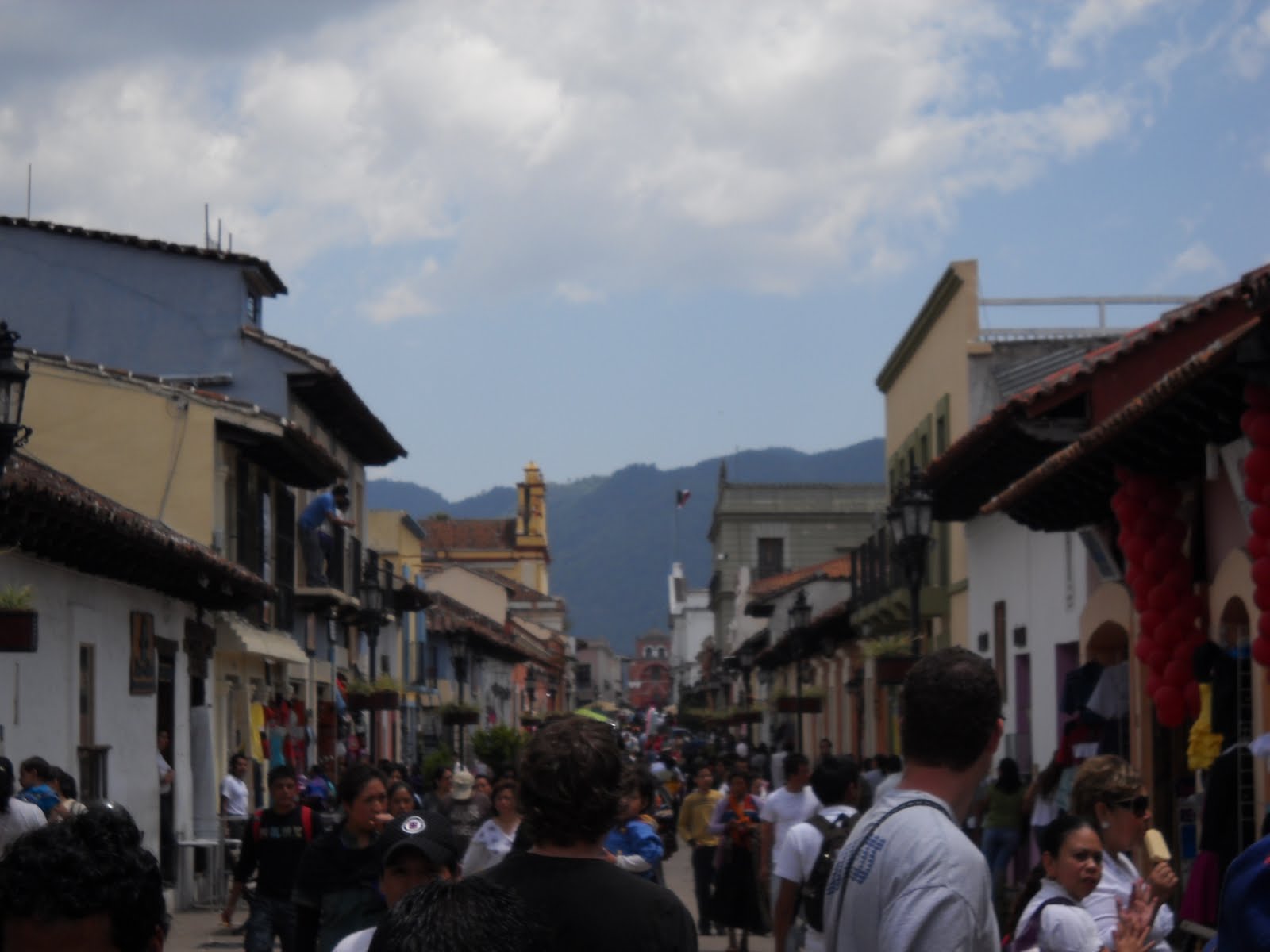
San Cristobal also has two main pedestrian-only thoroughfares, something that certainly contributes to its consumerist vibe. It was a welcome change to not have to dodge honking cars every few seconds like in Xela, and it was nice that the commercial districts weren't solely populated by tourists, like they are in Antigua. Here's a snapshot of one of these avenues:


And the other pedestrian section of town:


This photo was taken Saturday afternoon. Whereas Xela wakes up at dawn, San Cristobal didn't really get humming until after 10:30. Definitely a more laid back vibe!

And here's the cathedral:


The city recently finished refurbishing the facade. I don't think this picture does it justice, but the carving and stonework is unbelievably intricate. The tents in the bottom corners of the picture are the outer fringes of the artisans' market. I enjoyed wandering through the aisles of crafts and textiles and comparing the wares to what I've encountered in Guatemala - the two countries' products are similar enough that both are clearly Mayan, but there are sufficient differences in materials, colors, and patterns to demonstrate the distance between highland Guatemala and southern Mexico.

The highlight of my four days in Chiapas was undoubtedly a speedboat tour through the Sumidero Canyon. The canyon is a natural formation, but the boat excursions have been facilitated greatly by the construction of the dam to regulate water levels. Here's a picture of the hydroelectric dam, with an imposing sculpture commemorating the engineers and workers who made it all possible:


And here is a sample of the stunning scenery within the canyon:


I took almost a hundred other photos from the tour, so if you're particularly interested you can check out the shutterfly account (katyphelpsmiller.shutterfly.com; password is rice09). The point in the canyon pictured below, with the three walls converging around the river bend, is found on the departmental crest of Chiapas:


We saw all kinds of wildlife on the tour, as well. Here is buzzard beach (playa de los zapilotes):


And a crocodile!!


And finally, the triumvirate of traveling champions:


And that wraps it up from Chiapas.

In other non-traveling, non-clinic news, the city of Xela suffered a terrible sporting blow Saturday night when the Super Chivos (super goats) of Xelaju MC lost in the soccer season championship to the Rojos (reds, like the color) of Municpal from Guatemala City. Though the citizens of Xela were upset to lose the game, they couldn't in good conscience let their firecrackers and noisemakers go to waste, so the city was noisy - if defeated - until the wee hours of the morning. It was a disappointing way to commemorate the 486th birthday of the city.

The coming week should hold lots of educational excitement in the clinic as well as a trip to Lago de Atitlan to meet up with the Rice international group service project over the weekend. I also have plans to implement my Nana's suggestions for cooking turnip greens tomorrow evening, hopefully continuing my string of successful transfers of Southern American recipes to highland Guatemala. If squash casseroles and hash browns can make the transition, I'm hoping greens cooked with bacon can follow suit. Stay tuned! Until next time,
Katy

Tuesday, May 4, 2010

A day late and several lempiras short

Happy May Day to all! To celebrate el Día del Trabajador, the clinic closed this Monday, and since a three-day weekend resulted, I had no choice but to take a fabulous trip. This weekend's excursion: Copán Ruinas, Honduras.

The modern town and the ancient Mayan city are just across the Honduran border, a 9-hour trip, give or take, from Xela. Scott (the novio), Joe (a friend and former homestay brother), and I left at 3:45 Saturday morning and arrived without any grand problems around 2 in the afternoon the same day. The town of Copan Ruinas is pretty tiny, especially compared to Xela. From the Parque Central, Copan extends about 4 blocks in each direction. So while certainly not the 20,000 inhabitant seat of Mayan power it was 13 centuries ago, Copan today is just the right size for a weekend getaway.

Saturday afternoon, we wandered around the town and explored what Honduras has to offer in terms of licuados and beers. After this weekend, I can much more highly recommend the fruit juices (papaya, watermelon, and orange = best combination I've had in Central America) than the beers (there are 4 national beers in Honduras: Imperial is by far and away the only decent one. Barrena is a distant second, and Salvavidas and Port Royal are hardly worth trying). Also, we discovered baleadas, a giant flour tortilla (the Xela tortillas are all maiz) filled with black beans, cream, and eggs, then folded in half and lightly fried on a skillet. Delicious.

After indulging ourselves gastronomically, we climbed a hill outside of town looking for the former jail. Both Lonely Planet and Moon Guide informed us that the jail offered some scenic vistas overlooking the town, and when we found the jail, not only did the views live up to the hype, but a children's museum of Mayan history was housed inside as well. Double success! Here are Joe and I are gazing over la ciudad:


We rose and shone early Sunday morning to make it to the ruins before the mid-day crowds and the heat. Coming from highland Guatemala, it was a bit of a shock to be sweating in the jungle humidity, but then I remembered I used to live in Houston and I got used to it.

The ruins were of course spectacular. If Tikal is widely considered the Manhattan of the Mayan World, then Copan is popularly likened to the Paris. Both Tikal and Copan were major area hubs with lots of royal power and strong citizen bases, but Copan was a bit more artsy from what archeologists can tell. The sculptures and stellaes around the city are breathtaking.

Here are Scott and Joe posing next to the road sign, helpfully informing us that the ruins are straight ahead:

And we met some scarlet macaws at the park's entrance. Here is one, plotting and conspiring, in the bottom right corner of the photo. Minutes later, it would divebomb Scott as he passed by:

This photo is taken from the ruins' first main plaza. The stellae (the stone carved totem poles) were awesome. Most of the stellae displayed were from the 7th and 8th centuries, during the reigns of 18 Rabbit and Smoke Jaguar, if I remember the kings' names correctly.


And another stella!

This staircase is the largest carved staircase with inscriptions in the Mayan world. It was commissioned after one of Copan's kings was captured and beheaded by a rival city-state, and the beheaded king's successor wanted to reestablish Copan's claim as a pre-eminent Mayan kingdom. The stairway has over 60 steps, including some protruding sculptures, and tells the story of 400 years of Copan's glory.


Pretty magnificent. Also magnificent is this picture taken from atop the acropolis of the Temple of Inscriptions:

This photo is from atop the same acropolis, but looking over the Plaza of the Jaguars:


Apparently the citizens and priests of Copan used to sacrifice Jaguars to the honor of their kings, which just blows my mind. That means they had to first capture a jaguar alive, bring it out of the jungle and back to the city, and then lay it on top of an altar - still alive - before sacrificing it. I would most certainly not want to be part of the group assigned that task.

This photo is taken from within the Plaza of the Jaguars. I'm modeling the pose of the dancing jaguar king to my left:

Finally, this picture is from the residential area of the ruins. The bigshots and nobles lived here, right below all the major temples and plazas:


The ruins were a brilliant way to spend a Sunday morning, and if any of y'all are ever in (or close to) Honduras, I highly recommend the excursion.

Aside from our Honduran adventure, the rest of the week went really well, too! The new school groups coming in have been a delight to teach. Scott and I have been presenting lessons to 5th and 6th grade classes, and these kids are not nearly as surly or shy or awkward as I remember being between the ages of 10 and 13. These classes get the double whammy of basic nutrition and hygiene + puberty, and they handle it fantastically. I certainly would not want to participate in a group matching game about changes you experience in puberty, but these kids seem to enjoy sorting items like "pubic hair", "wider hips", "attraction for the opposite sex", "acne", and "erections" into categories. It's great fun. We have 5th graders coming through the end of this week, and I will try to get some pictures of the puberty matching game for next week's blog entry.

Attendance has also been excellent - each day we've been teaching two classes because over 30 students have come to their field trip. Whereas a couple weeks ago, we were asking teachers to mark on a roster which students had shown up, this week we only had to ask that they mark the absent students, and the highest number of absences in one class has been three. It's tiring but inspiring.

Since we only receive school groups Monday through Thursday, Friday has traditionally been a low-key day for the education team. We check in as to how the week went, what to expect for next week, and prepare any materials or lessons that need work. The past couple weeks, however, Scott's been called up from the education squad to the medical varsity team and has been designated as the wart burner. Every Friday the clinic applies nitrogen to any warts any community member may have, and Scott has assumed his new role with gusto. Here he is with a new amigo:

What a champ!

Between observing Scott eliminate warts, teaching puberty lessons, and 9 hour road trips to Honduras, the week flew by. I managed to squeeze in three yoga lessons, a French restaurant excursion for a friend of a friend's despedida (good-bye party), and a visit to BakeShop for handmade cinnamon buns. Life continues to be stupendous in Xela.

Hasta la semana que viene,
Katy

Sunday, April 25, 2010

Temblor, Truck, or Thunder?

Buenos Noches from Xela!
As of this week, I have a new favorite game in Xela. Scott and I call it "Temblor, Truck, or Thunder?', and like the name suggests, the game consists of guessing whether the loud, throbbing noise we just heard and felt was a brief temblor (an earthquake registering less than a 7.0), a truck with a wicked sound system and no muffler driving by over the speed limit and shaking the walls, or a thunderclap emanating from somewhere further up in the hills. There have been plenty of all three possibilities this week - the rainy season is a few weeks away and I think the thunder is getting warmed up for opening day; my host mother told me that little earthquakes signify the shift in weather patterns, which seems plausible to me at least; and noisy trucks are ever-present.

When I wasn't busy playing my new game, the clinic kept me occupied. The education team finished up with Llano del Pinal, the largest school in the valley, this week and I'm happy to be moving on to a new community. Though Llano is the largest and most prosperous community in the Palajunoj Valley, attendance rates for the class field trips to the clinic for check-ups and education lessons were atrocious. Less than half of all students, kindergarten through 6th grade, visited the clinic during their classes' assigned days. One theory is that Llano's relative wealth acts as a disincentive for clinic visits, in that families are less enticed by free health care. It's possible that families feel that since they live in concrete houses with running water, parasites and other diseases are not an issue. Judging by the number of students we did distribute medicines to, however, I don't think that's entirely the case. Also, when we visited the school to hand out medications to the niños who had come on their field trip, the students who hadn't made it to the clinic seemed enthusiastic about Primeros Pasos in general, and very excited about the possibility of returning for a consult at a later date. A mysterious and frustrating situation!

Whatever the reasons for the absent students, it was disappointing to see all the preparation and effort put in by the Primeros Pasos staff only reach half of the intended audience. We're hoping that with a different school starting their series of field trips this Tuesday, attendance rates will improve significantly. The students who did make it to the clinic this week, however, were tremendously fun to work with. Monday, Tuesday, and Wednesday brought classes of kindergartners and preschoolers, who were impressively attentive and very cute. The main thrust of our lessons for the littlest kids is healthy choices - the difference between good foods and bad foods, washing your hands often, brushing your teeth regularly (we give them soap and a toothbrush after their visit), and throwing your trash in a trashcan. One little boy raised his hand while the class was enjoying their bananas (the healthy snack they get after they wash their hands) and explained that sometimes, during Christmas, his family makes cakes and was it okay, during Christmas, since it was a holiday, to eat cakes to celebrate the season with his relatives? It was hard not to laugh, but I didn't want to offend him since he was so concerned. We explained that yes, eating sweets and desserts from time to time is fine, and that the important thing to remember is to eat far more good foods than bad foods every day.

Thursday's class was exciting as well, though not nearly as cute. The larger communities in the valley have Accelerated Primary School programs that offer a way for non-traditional students to cover grades K-6 in two years. I was impressed by these students' courage and dedication - it takes a great deal of each to start with kindergarten lessons as a 10-year old, for example. Over 25 students from the Accelerated program came to the clinic Thursday, and Scott and I had our hands full. We taught two different lessons, which was exhausting but really fun. The students were alert and eager to participate, and I was glad to finish Llano's lessons on such a high note.

Outside of the clinic, Scott and I took an adventure to Totonicapan on Saturday afternoon. This picture below might be my favorite taken in Guatemala thus far:


Totonicapan is about an hour outside of Xela by bus, and the views of the valley on the ride over are almost worth the trip itself. The village is also far more indigenous than the big city of Xela - Scott and I were the only two white people we saw in the town all day. We chose Totonicapan because it has a Saturday market, and we heard that the town itself was also quite pretty. The little girl above dashed into the picture as it was being taken, and I didn't notice she was in the photo until I uploaded all the shots onto my laptop. Not only is she precious in a pink and purple traje, but the fountains are painted like jaguars! The cathedral is on the left in the background and the municipal theater is to the right. I liked the landscaping in this town square as well - there were lots of flowers in bloom around fountains.

Totonicapan also has the distinction of having TWO town squares. I have no idea why, but it doubled the amount of photo opportunities. Here is a statue commemorating the 19th century indigenous peasant rebel leader Anastasio Tzul in the second central plaza:


As with most things in Guatemala, it helps to have a sense of irony. Though it's a nice populist gesture to have Tzul commemorated in a statue, it would be much more befitting of his legacy to enact policies to benefit those he fought for almost 200 years ago. Namely, the still-marginalized Maya, the socio-economically disadvantaged, and rural residents in general.

Anyway, here I am in the second central plaza, slightly in front of and to the left of Mr. Tzul's statue:

This fountains have jaguars, too!

Visiting Totonicapan on a market day - though I couldn't pull the trigger on bunnies, bags of chicken feet, or yards of fabric - was an opportunity to participate in an authentic highland Guatemalan experience. Similarly, I spent Wednesday night in a cooking class focused on chapin (local parlance for 'Guatemalan') specialties. This week's lesson? CHILE RELLENOS! Here they are, just after stuffing:


And here they are, ready to eat! MMMMMMMMM.....


Though time and labor intensive, the recipe is not technically challenging and I am excited to give it a try in the Entremundos kitchen the next time I pick up some peppers in the market.

Finally, I wrapped up the week with an ecclesiastical celebration. The church I've been going to is Saint Mark's/San Marcos Episcopal, and today was the feast of Saint Mark AND confirmation Sunday AND the bishop was there. It was a big deal. The requisite marimba band was present, of course, for the post-service celebration, and everyone was definitely in a mood to celebrate since the bilingual service contained baptisms, confirmation, communion, and all the scripture readings twice (once each in English and Spanish). In addition to the marimba, the beef stew, loads of cupcakes, and watermelon smoothies, however, was a teenage alternative rock band. I had to take a picture:

The bishop seemed impressed.
I, in turn, was impressed with the bishop although I didn't get a photo. His home church is in Chichicastenango, and his outfit (mitre and all) were custom-made in the traditional textiles and colors from that region of Guatemala. It was beautiful, and I liked the respect and significance behind the action, too. Hooray for church authorities with social consciousnesses!

This concludes another week's post, and another month's worth of entries as well. Hasta mayo,
Katy

Sunday, April 18, 2010

C-c-c-cambios....

Happy post-Tax Day greetings to all my American friends!
Since I'm an aspiring graduate student living out of the country for six months, my parents kindly requested an extension for filing my taxes, so April 15th was not, in fact, my tax day. It was, however, my father's birthday and the day I returned to Xela from a 3-day vacation in Antigua. Both excellent reasons to celebrate!
Also a cause for celebration, mi novio of three years finally made it to Guatemala. I met Scott in the Guatemala City airport Monday afternoon and we took a shuttle to Antigua. Isabel and Jose, my homestay parents from last summer, graciously received us as guests and prepared us excellent Guatemalan breakfasts (refried black beans, eggs and tomatoes, chili sauce, fresh bread, cream cheese, orange juice, and coffee) each morning. To say that staying with them was delightful is an understatement.
Scott had never been to Central America before last Monday, and Antigua is a small enough, tourist-friendly city that his culture shock was mostly mitigated. Consequently, we got right down to the serious business of enjoying our vacation. For our first adventure, we visited the ruins of the San Francisco church, a former convent abandoned after a series of earthquakes tumbled the walls and convinced the city leadership to move the capital from Antigua to Guatemala City in the late 1700s. San Francisco is also the home of San Hermano Pedro's tomb, housing the mortal remains of the first Guatemalan saint. Here's a snapshot from the interior courtyard of the monastic ruins:


And now from another angle:

I thought the colors and the lighting were spectacular. Even though I spent four weeks living two blocks away from San Francisco last May, I had never visited the inside of the ruins, and I'm very glad to have finally checked that box.

Antigua also has its own mirador point overlooking the city, somewhat similar to El Baul or La Muella, two easy dayhikes I enjoy in Xela. I took the photo below right as the sun was beginning to set, and you can see the entire town of Antigua (about 12 blocks by 12 blocks in total) and the partially obscured Volcano Agua providing a dramatic backdrop.


Our final day in Antigua started with a bike tour of a nearby coffee plantation, something I highly recommend to anyone visiting the city in the future. The bike company (Quijote Cruisers) operates out of the front room of Isabel and Jose's house, and there's a dog named Estella who helps clients pick out their cruiser bikes. This is what an Antigueño coffee finca looks like:


The finca we toured sells to Starbucks and they use organic, eco-friendly methods of agriculture, including planting macadamia trees to naturally shade the coffee plants. Here I am whacking a macadamia nut shell with a rock, cave woman style, to get the nut inside. Our guide told me that squirrels have a better technique, but I feel like they have more practice cracking macadamia nuts than I do, so I'm okay with that.


After our 2 hour bike and coffee adventure that morning, Scott and I cleaned up and headed off to Las Capuchinas, another colonial ruin, except for this complex was a convent instead of a monastery. Here Scott is gazing over the former great hall:


The architecture is stunning, and I decided that if I had to be an 18th-century nun, living and working in Antigua's convent wouldn't be so bad at all.

It's high mango season in Guatemala, and I've been savoring the chance to buy them fresh and cheap in the markets. My technique, like with the macadamia nuts, clearly needs work since I can't eat a mango without covering my hands and face with pulp and juice, but I did convince Scott to carry two mangoes around Las Capuchinas until it was snack time. We had a mid-afternoon refacción in the garden (see below:)


Thursday morning, we took a 2.5 hour shuttle from Antigua to Xela and go settled into Entremundos, an NGO/pension house 3 blocks from the Parque Central. Entremundos is a partner with Primeros Pasos and they do a lot of really cool volunteer/development/sustainability work on their own. I'm excited to become a part of the community over the next four months. Also importantly, Entremundos has wireless, hot showers and an OVEN. Ovens are a rare commodity in rental housing around Xela, and I have already baked a squash casserole. I have big plans for brownies and other such delicacies as well.

Friday morning, Scott and I both headed to the clinic for his first day AND a big announcement - after a month or so of searching, Primeros Pasos has named a new director! Everybody is really excited about Margarita, la nueva directora, and I'm looking forward to working alongside her in the coming months. She is originally from the Valley and has been a practicing social worker for years, both traits that can really benefit the clinic's scope of operations. And though I've only interacted with her briefly, I hope that I can learn from her experiences and perspectives as a woman working in health care and development.

After the clinic meeting and announcement, the education team (currently consisting of myself, Scott, and the education director) hitched a ride with a medical student who has a car to distribute medicines to the students who visited the clinic last week. This was my second time handing out parasite meds in this school, and I was still struck by how excited the students were to receive anti-parasite drugs in front of their classmates. Instead of a stigma, it was a source of pride for the students receiving our attention. At the very least, the niños' excitement signifies an openness and willingness to discuss health issues, qualities often lacking in other public health intervention situations. And if the Guatemalan students aren't embarrassed to get anti-parasite meds in public, then there's really very little reason for anyone, anywhere, to be ashamed to receive healthcare treatment.

In my volunteer work on the clinic's development side, I'm still mastering Salesforce.com but I have grand plans to enter/organize all of the 2009 donations by the end of this week. Stay tuned for updates there. Outside of the clinic and a mini-vacation in Antigua to celebrate the boyfriend's arrival though, la vida quetzalteca continues as usual. A Dutch friend of mine turned 23 this week and we celebrated her birthday with a piñata Saturday afternoon - at one point, the majority of the party guests were speaking in Dutch amongst themselves and I had to remind myself that I was in Guatemala. Globalization, indeed.

The kindergartners are visiting the clinic this week as their field trip, there's a costume benefit party for Primeros Pasos Thursday night (the theme is nerds vs. monsters, if you have any dress up suggestions), and I've penciled in three different yoga sessions, so the next few days should be wonderful as well. The first two months in Guatemala have been fantastic and I'll be very fortunate if the trend continues! Besos until next time,
Katy